
Flexible flat feet in kids are one of the most common things we see at the clinic, so it’s no surprise to us that the reported prevalence is between 2.7 and 18.1%. However, to treat or not to treat remains a heated topic between health professionals (even among podiatrists 🫢), so today we are reading “Efficacy of Plantar Orthoses in Paediatric Flexible Flatfoot: A Five-Year Systematic Review“.
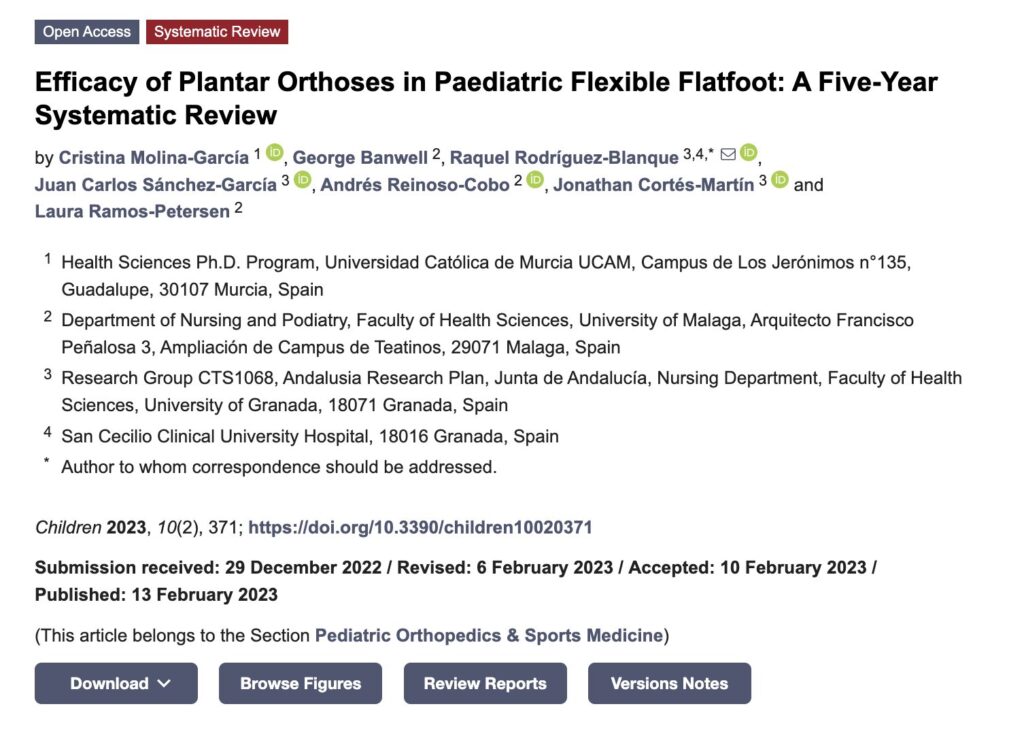
In a systematic review, researchers find research papers that meet the criteria of their research topic, and from there, they analyse the findings and use that information to answer their question. In this particular research, they reviewed 7 research trials, representing 679 participants with Paediatric Flexible Flatfoot aged 3-14 years.
Here are the key points from this research. Please note: the information presented below is directly taken from the research paper itself. Wording changes are only made to medical/technical terminology.
What Does Paediatric Flexible Flatfoot (PFF) Look Like?
Clinically flexible flatfoot looks like:
- flattening of the arch in a standing position,
- rolling in of the heel,
- prominence of the inside of the ankle,
- foot pointing outwards, and
- internal rotation of the leg.
What Do Health Professionals Think About PFF?
Some professionals see PFF as a physiological variant of foot development and that it will correct itself in time; but some think that flexible flatfoot during childhood will slowly lead to pathologies in the foot, ankle or structures higher up the leg, such as plantar fasciitis, Achilles and posterior tibial tendinopathy, hallux limitus and rigidus (reduced or complete lack of motion at the big toe joint), and patellofemoral pain syndrome (knee pain).
What Symptoms Can PFF Cause?
The most common symptoms are functional disability and general foot and leg pain. Although majority of cases are asymptomatic, there are biomechanical abnormalities, including:
- Decreased ankle dorsiflexion (ankle moving up)
- Increased rearfoot eversion (heel rolling inward)
- Increased forefoot supination (front of the foot rolling outward)
What Treatments Are Available?
Conservative treatments are the first-line treatment, including orthotics, corrective shoes, physical exercises, physiotherapy with joint manipulations. Surgery, while available, is reserved for feet with severe deformity, rigid flexible flatfoot or flexible flatfoot with persistent symptoms that do not improve with conservative treatment.
The most used conservative treatment is orthotics due to their lack of contraindications and because the active participation of the child is not required.
What Are the Purposes of Treatment with Orthotics?
The short-term purpose is to decrease pronator movement (rolling in), which decreases the tensile forces on ligaments, tendons and the plantar fascia.
The long-term goal is to reduce the pathological position of the foot and slow down the progression.
What Did The Researchers Find?
- Orthotics are an effective treatment with daily use during the daily activities of life.
- Orthotics may make structural changes, and that orthotics improve functionality and pain.
- Orthotics can modify children’s feet with immediate effect, but it is after 12 months when more changes and improvements are shown.
- The younger the patient is, the greater the possibility to correct the PFF.
- Long-term orthotic use is effective to improve alignment and coordination of the lower limbs.
- Orthotics are effective for reducing the characteristic signs and symptoms of paediatric flexible flatfoot and improving quality of life.
So, what’s our take?
What this research paper has found is consistent with what we have observed clinically. Kids respond to orthotics really well. Their symptoms tend to improve quickly once the biomechanical abnormalities are addressed. It just shows that childhood is a great opportunity to ensure their growing feet are set up well for years to come. Every child is different, from the feet to the daily life the feet carry, so a check-up is a great place to start.
At a foot check-up, we look at their foot posture, gait, range of movement and check for potential sore spots in the feet and legs. From there, you get a good idea of what’s happening and whether orthotics are indicated for your child. Your podiatrist will answer your questions, ensuring you leave with peace of mind!